Overview
Kaldheim is the Magic: The Gathering Norse mythology inspired set that launched in December 2020.
Problem Statement
Kaldheim is our second product page in the new CMS (Content Management System) of Contentful. Due to technology constraints during the Zendikar Rising campaign our team revisited our original A/B test to gain further insight into consumer behaviors in order to shape future campaign product pages.
Users and Audience
- Primary: Enfranchised Magic Players. These are individuals who want to know what is unique about the Magic set (such as mechanics, what cards are exciting, etc)
- Secondary: Lapsed Magic Players. Individuals who are familiar with the game but might not have played in awhile.
Roles and Responsibilities
Project Owner
Sara Nelson
UX & Project Lead
Anne Hendricks
Project LiveOps/Build
KJ Smith
Creative
Haven Agency
Wizards Creative
Elsa Monnier, Kelsey Johnston, Adam Willson, Mandi Huffman
My Role
UX & Project Lead
- Become subject matter expert on campaign
- Maintain project schedule and timelines from project kick-off through point of sale
- Define technical requirements and roadmaps for new web enhancements
- Collaborate with Project Owner, LiveOps, Internal Creative as well as CRM and UA on innovative campaign web solutions that achieve business goals and drive engagement
- Outline web marketing plan through each phase
- Coordinate timelines and ecosystem mapping
- Pitch web marketing plan to Senior Marketing Manager, Digital Direct Marketing Director, Brand Manager and UA Director
- Outline creative requests for Internal Creative team and oversee development
- Manage vendors for creative and development
- Work with LiveOps through build process
- Communicate with internal stakeholders
Scope and Constraints
- 3 Product Pages for A/B testing.
- A minimalist product page known as a stub page. The purpose of the stub page is to allow us to turn on the product page URL before debut. For Kaldheim the target for the stub page launch was a month before the debut moment (Zendikar Rising had been a few days before debut)
- New widgets. Kaldheim featured a new Plane (universe in the multiverse) and characters we wanted to develop new widgets to measure customer engagement.
- Timeline. With the holidays the Marketing team wanted a prebeat a month before the debut to hype for the holidays.
- Other High Priority Projects. Along with the marketing campaigns other re-design projects for the Magic: The Gathering website were in progress.
- Updates to MTG Arena website in support of campaign beats (preorder and available now)
- Magic homepage updates in support of campaign marketing beats.
Process
At the start of the Magic marketing campaign the Brand Managers do a breakdown for the Marketing channel leads, including key highlights, timelines for what is to come from debut, to timing for product sales. As Lead, I typically start examining the cards as well as world guides to address:
- Key Selling Points
- What is unique about the set
- What is different from previous sets? Example: are the sellable products different? Are there new products available?
- What are the digital tie-ins with MTG Arena and Magic Online?
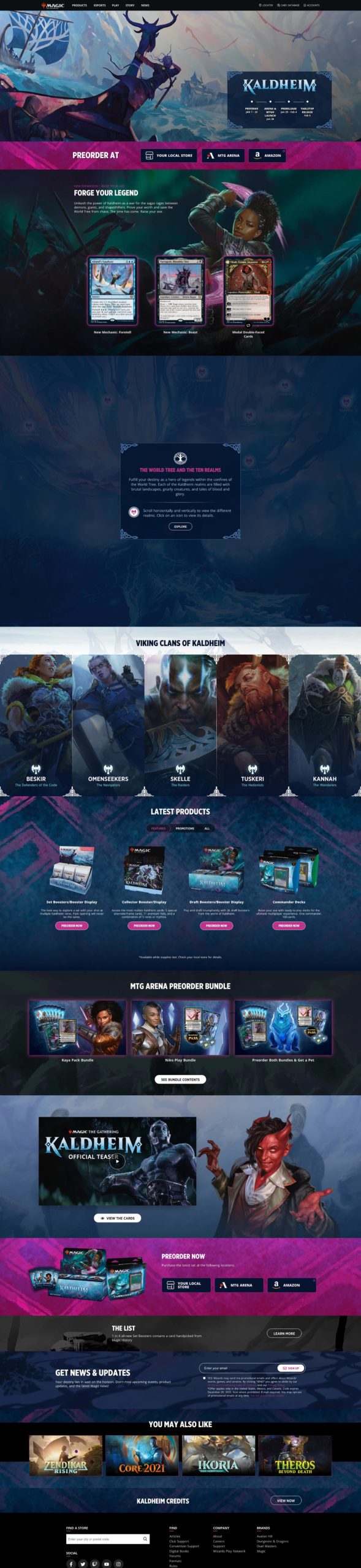
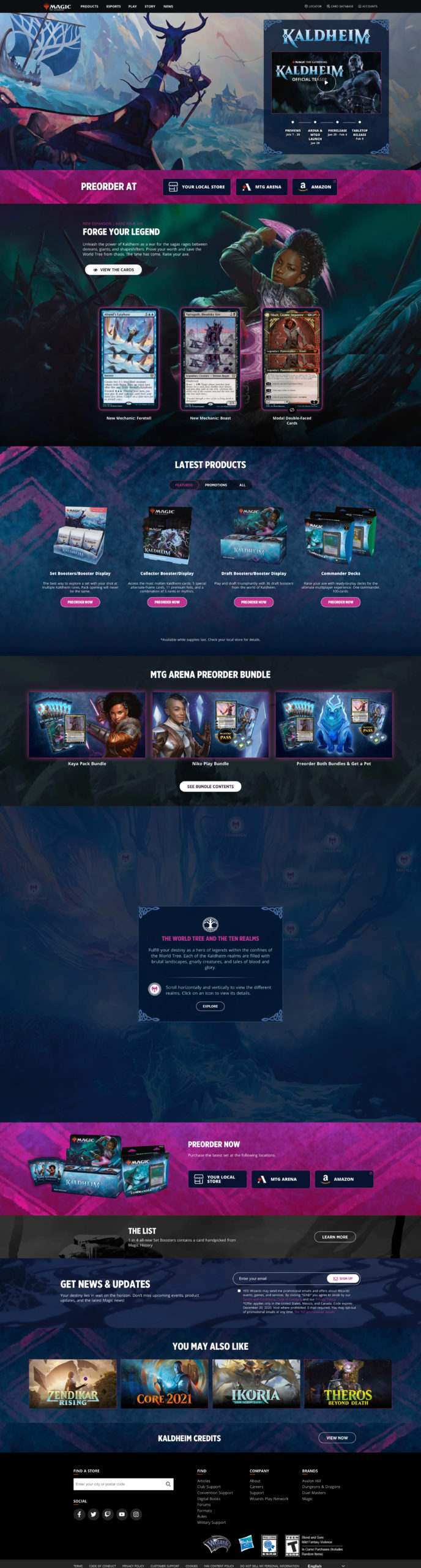
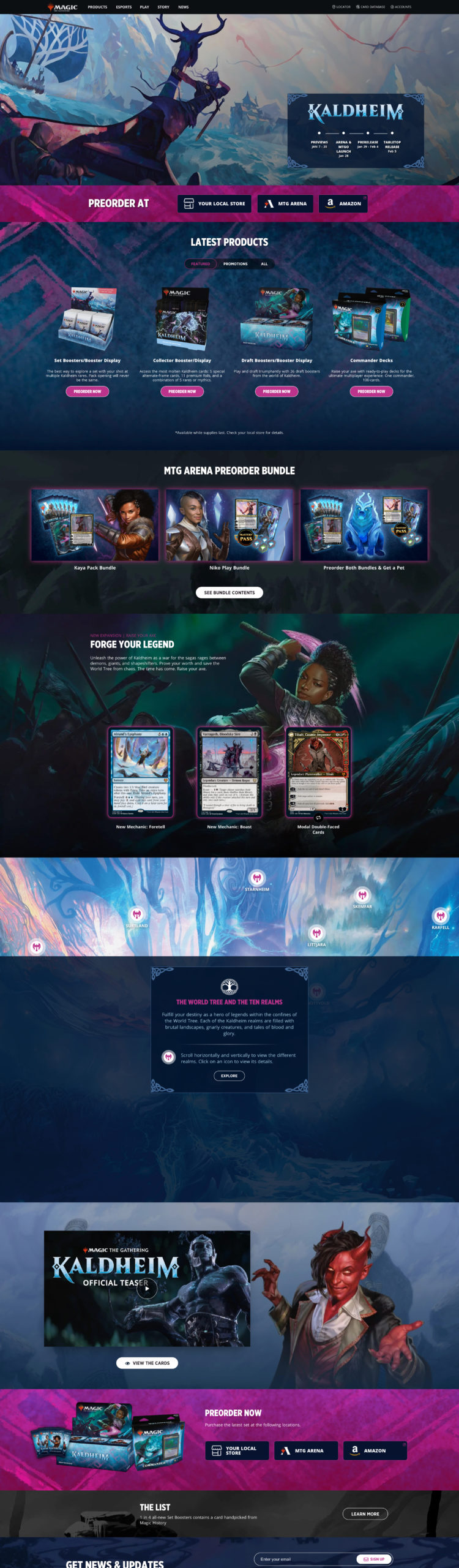
For the A/B test we wanted to test our original theory that a product page geared to a story rich experience would perform better than a high-level campaign overview page. For Kaldheim the CRO team also wanted to start testing a third direct response version that would be a landing environment for the paid media advertising.
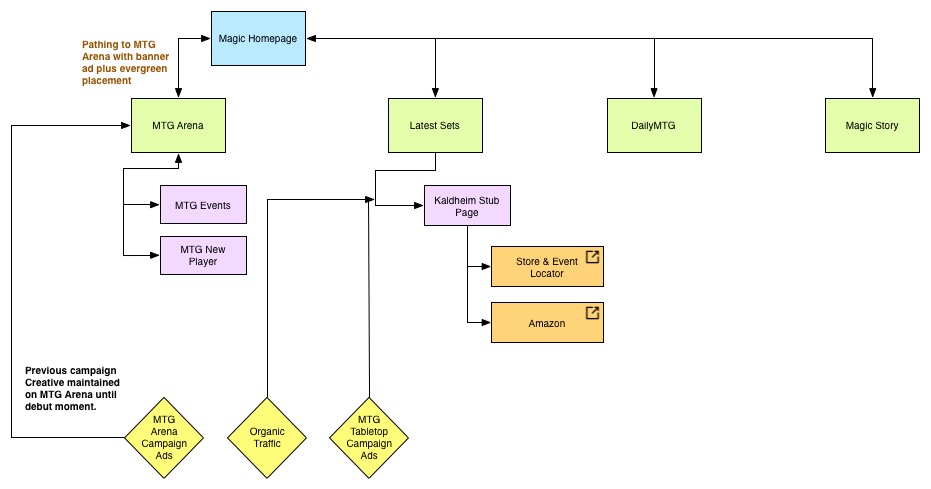

Our KPIs for the campaign were:
- Primary: tracking clicks to Local Game Story, Amazon and Arena
- Secondary: clicks to Card Image Gallery (CIG) and trailer
With our KPIs we wanted to establish a baseline of metrics to measure future campaigns. Our high-level campaign overview page (Variant A) would act as the baseline to measure the story rich experience product page (Variant B) and direct response (Variant C).
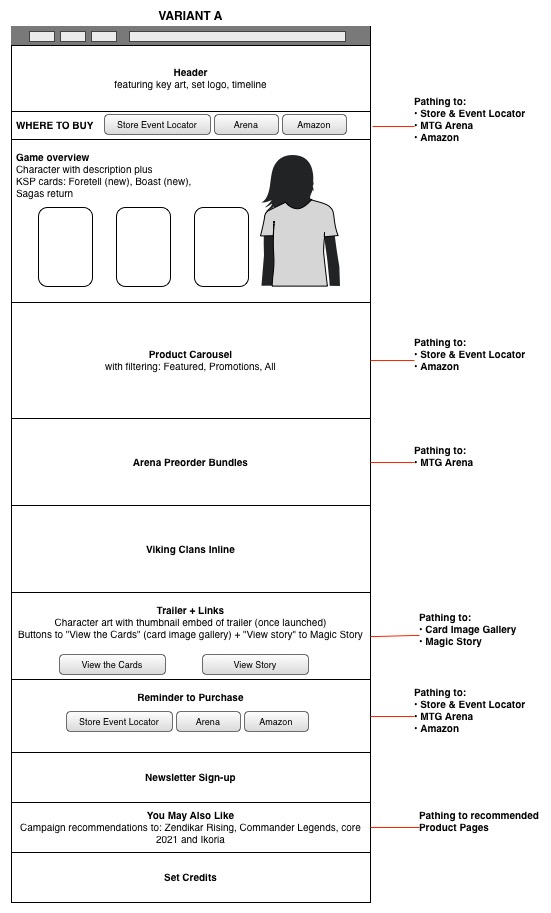
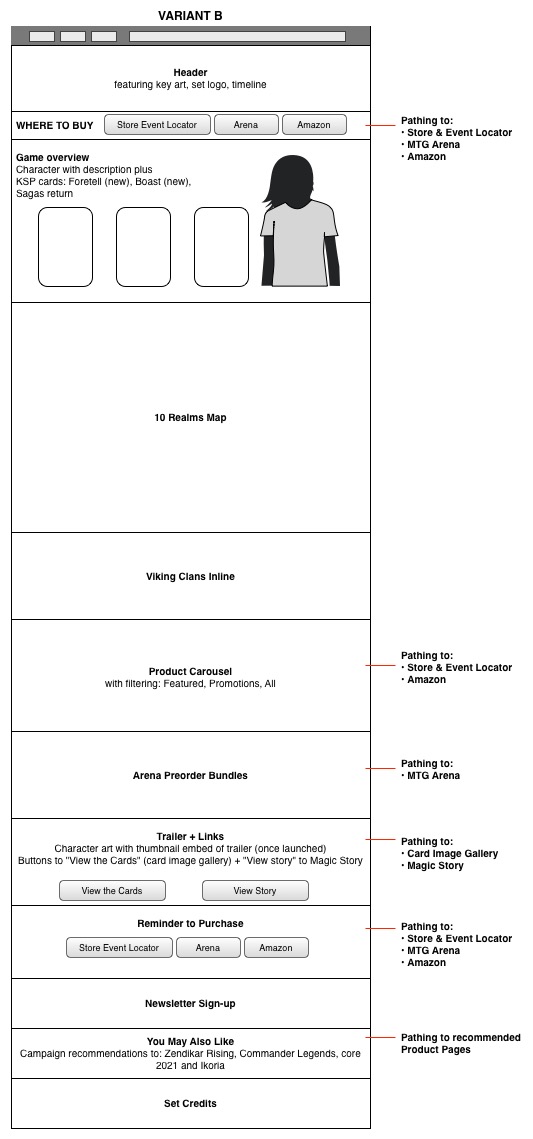
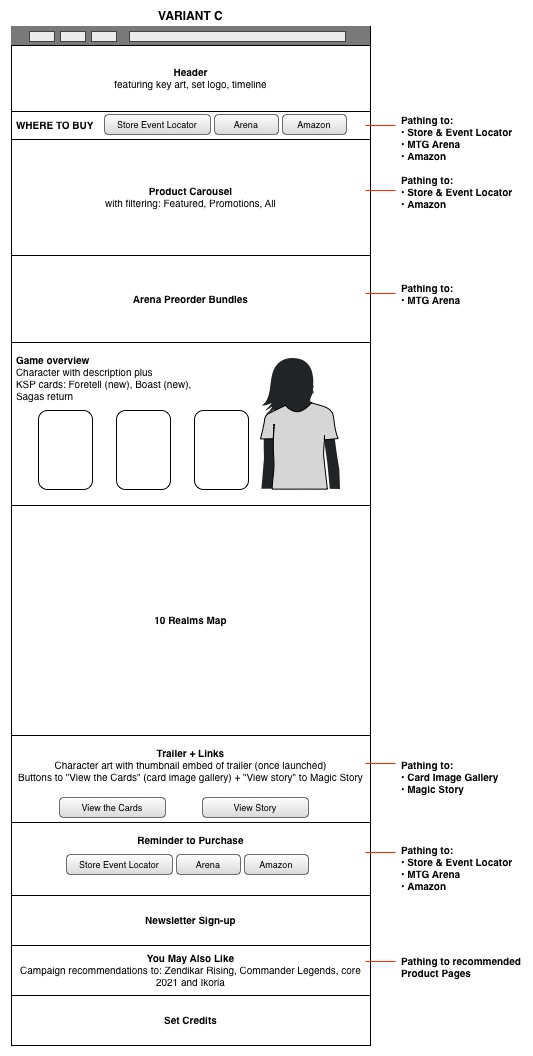
In early brainstorming for the story rich experience the team gravitated toward the idea of highlighting the Plane. The Viking world had a World Tree with 10 Realms. What better way for the users to engage than an interactive map they could click to get more information? Similarly I proposed a new accordion widget that consumers would be able to interact with to learn more about the viking clans and see the characters preview card (pending card preview schedule).
Once I had outlined and pitched the marketing plan to our teams Director and the Brand Manager technical requirements were outlined. From there I scheduled kick-off calls with our vendor to discuss the technical requirements provided and discuss schedule. Once wireframes and designs had been reviewed with UI/UX feedback provided, I ran through QA scenarios of the product page in development along with our LiveOps.
Outcomes and Lessons
- Shifting dates. Marketing moved the prebeat date (before the debut moment) after localization of the stub page had already been submitted and build had happened. With every project I schedule and run check-in meetings with stakeholders to walk through the pages then have follow-up emails. A few days before launch another follow-up email is sent to ensure everything looks good for launch which is when the new prebeat dates were caught. Being through in communications and sign-offs ensured information was accurate.
- Higher click-through rates. Compared to Zendikar Rising the click through rates on Local Game Store, Amazon and Arena increased 0.52 – 1.15%.
- The product page had 1.86 million sessions over 61 days and a 64% bounce rate.
- The direct response product page and story rich experience outperformed the baseline in click-through rates. This confirmed our hypothesis that our players are interested in what makes the set unique; however, the World Tree map had very low click-through rates especially on mobile devices. We decided that the information given wasn’t engaging enough for users to be interested to really engage especially since it was information known from the debut video and no cards we used.
- Improved page load times to less than 6 seconds (Zendikar Rising was 8.54 seconds). Rapid page load times were a priority goal so seeing load times decreasing was encouraging. LiveOps and I went through the product page to investigate potential sources for longer load times so we could make improvements for the next campaign.
Final Product Pages